
Intraoral Cameras
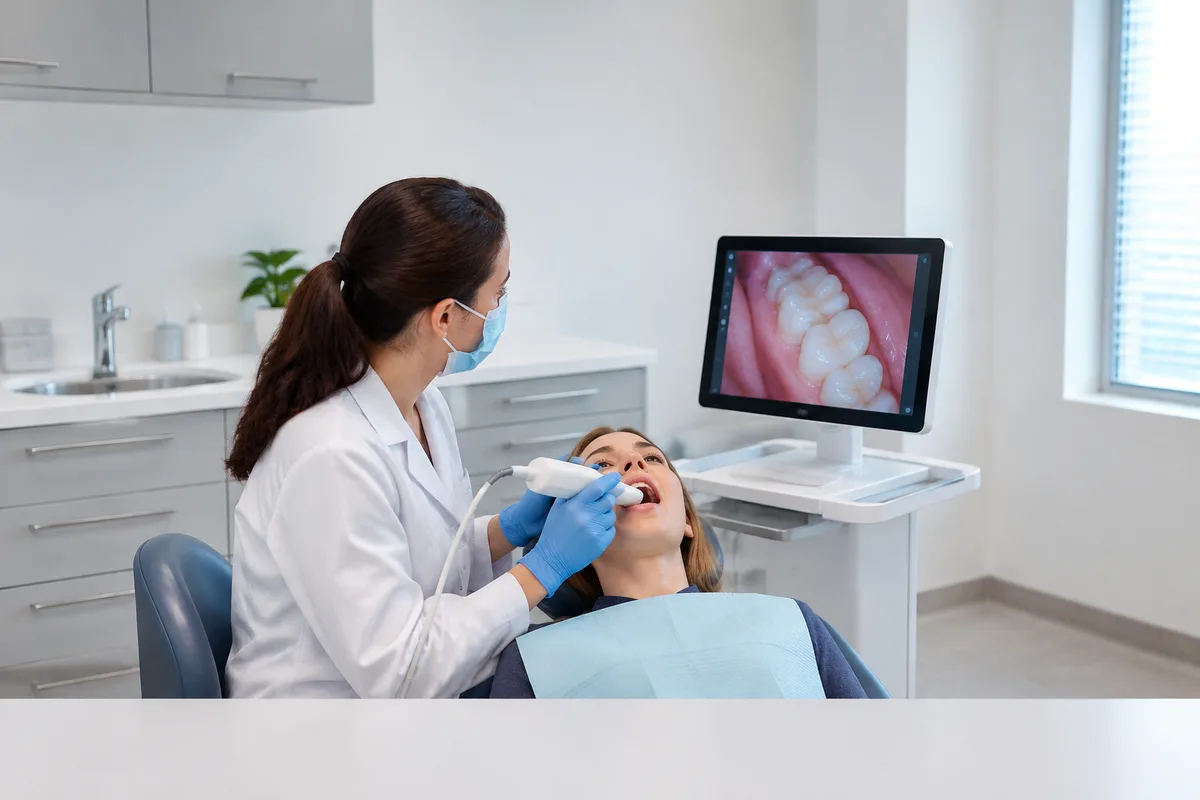
Intraoral Cameras
An intraoral camera is a small, pen-shaped camera that lets your dental team see and show you the inside of your mouth in close detail. If you have ever wondered what your dentist is describing when they mention a worn edge or a cracked filling, this tool helps you see it for yourself.
What intraoral Cameras is
An intraoral camera is a handheld device about the size of a thick pen, with a tiny lens and light at the tip. It is guided gently around the teeth and gums, and it sends live images to a nearby screen. The images are greatly magnified, so small details become easy to see.
Before cameras like this, patients mostly relied on a dentist's verbal description and a small mirror. A mirror shows only a limited angle, and the patient usually cannot see what the dentist sees. The camera improves on this in two ways:
- Magnification — fine details such as hairline cracks, worn enamel, chipped edges and gum changes are easier to spot on screen.
- Shared view — you and your dental team look at the same image, which makes conversations more concrete.
- Saved images — pictures can be kept in your record, so changes can be compared from one visit to the next.
An intraoral camera is a visual tool. It does not replace X-rays or 3D imaging, and it does not treat anything. Its job is to help with seeing, explaining and documenting.
How we use it at Sam’s Smile Dental
At Sam’s Smile Dental, intraoral cameras are part of the on-site equipment that supports clear communication between our team and our patients. Dr. Sam Kreit (DMD, DDS) leads our team. Whoever is caring for you can use a camera image to point out what they are seeing and explain why it matters.
A camera image shows the surface of a tooth and the surrounding gums. Other tools at our office answer different questions:
- Laser cavity detection — helps identify weakened areas of a tooth and supports earlier detection of cavities.
- Cone beam imaging (CBCT) — creates three-dimensional images when a closer look at underlying structures is needed.
A camera picture can also help when a patient is considering treatment such as composite fillings, crowns, bonding, veneers or a smile makeover, because it gives everyone a clear starting point to discuss. Ask our team how the camera fits into your own visit.
What it means for you
Dental problems often develop without much sensation, so it can be hard to know what your dentist means when they recommend something. Seeing the area on a screen turns an abstract explanation into something you can follow.
- Clearer understanding — you can see a crack, a worn spot or an area of inflammation rather than taking it on faith.
- More informed decisions — when you understand the reason for a recommendation, it is easier to weigh your options and ask questions.
- Better tracking — saved images give a reference point to compare against later.
- Comfort — the camera is small and is used on the surfaces of your teeth and gums, so most people find it easy to tolerate.
- Easier sharing — pictures can help explain your situation to you or a family member, and they can support communication with other providers when appropriate.
What to expect during your visit
Before. You do not need to prepare in any special way. Brush and floss as you normally would, and tell your team about any teeth that feel sensitive, chipped or sore so they can look at those areas closely.
During. As part of an exam or another appointment, your dental team may guide the small camera around your mouth, usually one area at a time. You may be asked to open wide or turn your head slightly. The images appear on a screen where you can look along with them, and you are welcome to ask questions about anything you see. Most people feel only the light touch of the camera tip, if anything.
After. There is no recovery time and no restriction on eating, drinking or going back to your day. Your team may talk through what the images showed and whether anything needs attention, now or later. How long the camera portion takes depends on how much needs to be viewed, and it is usually a small part of the appointment.
Frequently asked questions
Is an intraoral camera safe?
Yes. An intraoral camera is a small, light-equipped lens that views the inside of the mouth. It does not use radiation, so it is different from X-rays. Cameras are cleaned and protected between patients according to standard infection-control practice.
Does it hurt?
It is not expected to. The camera rests on or near the surfaces of your teeth and gums and is not used to drill or treat. If an area is tender, tell your team and they can be more careful around it.
How often is it used?
That depends on your needs. It may be used during a routine exam, when you have a specific concern, or when treatment is being discussed. Ask our team how often images would be useful for you.
Who is it suitable for?
Intraoral cameras are generally suitable for children and adults alike, since they only view the mouth. They can be especially helpful for anyone who likes to see and understand what is happening before agreeing to care. If you have a strong gag reflex or dental anxiety, let your team know so they can adjust their approach.
If you would like to see your own smile up close, book a visit with Sam’s Smile Dental or get in touch to ask about intraoral cameras.
This content is for general information only and isn't dental or medical advice. Talk with your dentist or orthodontist about your own situation. If you have a medical emergency, call 911.