
3D Digital Scans
3D Digital Scans
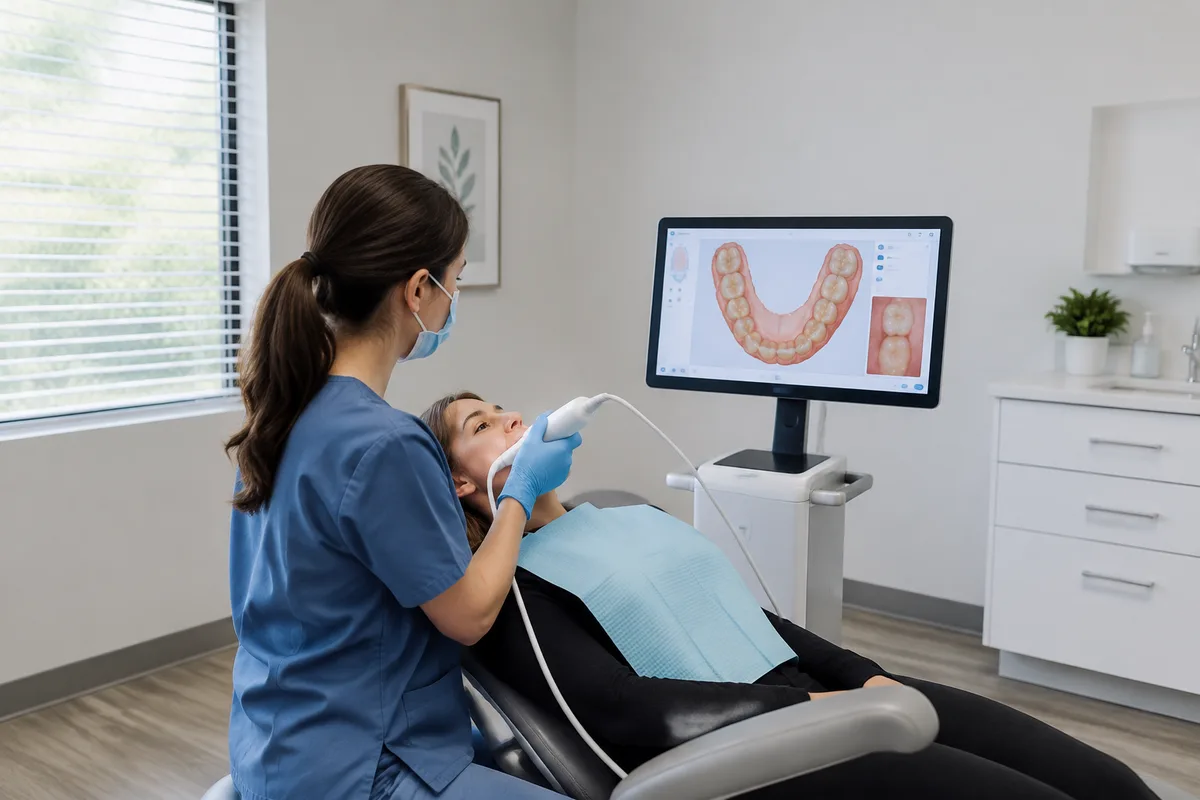
A 3D digital scan gives your dentist a three-dimensional view of your teeth, jawbone, and surrounding structures, instead of a flat picture. At Sam’s Smile Dental, this kind of imaging is available on site through our Cone Beam technology. This page explains what it is, how it is used, and what a visit involves.
What 3D Digital Scans is
Traditional dental X-rays are two-dimensional. They flatten the mouth into a single image, so structures can overlap and some details are hard to judge. A 3D digital scan captures many images as the scanner moves around your head, and software combines them into a model that can be viewed from any angle.
The type of 3D scan we have on site is cone beam computed tomography (CBCT). It uses a cone-shaped X-ray beam to create three-dimensional images, and it is used to look at structures a flat image can’t show well. Because the dentist can rotate the image and look at it in slices, there is less guesswork about depth, position, and spacing.
In general terms, 3D scanning improves on older methods by:
- Depth — showing how thick or deep a structure is, not only its outline.
- Separation — reducing the overlap that can hide detail on a flat X-ray.
- Visualization — letting the dentist and patient look at the same clear image together.
How we use it at Sam’s Smile Dental
Our Cone Beam is one of the on-site facilities at the practice. It creates 3D images, which can help Dr. Sam Kreit understand what is happening beneath the surface before he recommends treatment.
Detailed 3D views are commonly used in planning treatments where position and bone matter. Among the services we offer, these include:
- Dental implants — judging the bone available and the position of nearby structures. Dr. Sam has taken advanced continuing education courses on dental implants.
- Implant supported dentures — understanding the jaw before planning a restoration.
- Tooth extraction and wisdom teeth removal — seeing how a tooth sits in the jaw.
- Root canal therapy — examining the area around a tooth that is causing trouble.
Whether a 3D scan is right for you is a clinical decision. Your dentist will decide based on your situation and what needs to be seen.
What it means for you
For patients, the main benefit of 3D imaging is clarity. A treatment plan built on a three-dimensional view rests on more information than one built on a flat picture alone.
- Better understanding — seeing your own anatomy on screen can make a recommendation easier to follow.
- Careful planning — detailed images support more precise planning for procedures like implants or extractions.
- Fewer surprises — knowing the layout ahead of time helps your dentist prepare.
- Comfort — the scan itself is external. Nothing is placed under the skin, and you are not asked to bite down on hard film holders in the way some traditional X-rays require.
What to expect during your visit
Before. Your dentist or a team member will explain why a scan is being recommended. Tell us if you are or might be pregnant, and mention any questions about imaging. Be ready to remove glasses, earrings, or other metal items near the head, since these can interfere with the image.
During. You will be positioned in the scanner and asked to stay still while it rotates around your head. Staying still helps keep the image sharp. Generally the scan itself is short, often under a minute, though the whole appointment takes longer because of positioning and discussion. Ask our team what to expect for your specific visit.
After. The images are ready for your dentist to review, often right away. You can look at them together and talk through what they show and what options make sense. There is generally no recovery period, and most people go about their day as usual.
Frequently asked questions
Is a 3D scan safe?
CBCT uses X-rays, so it involves a small amount of radiation. Dentists weigh that against the benefit of seeing what they need to see, and scans are generally taken only when the added information is useful. Tell us if you are pregnant or think you might be.
Does it hurt?
The scan is not an invasive procedure. You stand or sit still while the machine moves around you, and most people describe it as simple. If you feel anxious in enclosed or unfamiliar spaces, let our team know beforehand.
How long does it take, and how often is it needed?
The scanning itself is generally brief, though the full appointment includes setup and review. A 3D scan is not a routine part of every visit. Your dentist will recommend one when your situation calls for the extra detail.
Who is it suitable for?
It can be considered for many adults and sometimes for younger patients, depending on the clinical question. It is often discussed when planning implants, extractions, or other treatment where bone and tooth position matter. Your dentist will tell you whether it makes sense in your case.
If you would like to know more about 3D Digital Scans or whether one could help with your care, get in touch with Sam’s Smile Dental and ask our team.
This content is for general information only and isn't dental or medical advice. Talk with your dentist or orthodontist about your own situation. If you have a medical emergency, call 911.